China’s cosmetics supply chain attracts brands seeking flexible production, competitive costs, and a wide range of packaging options. Yet choosing among private label makeup manufacturers takes more than comparing catalog photos or quoted prices. McKinsey’s 2023 beauty-market analysis estimated that global beauty sales reached about $430 billion in 2022 and could approach $580 billion by 2027. That growth creates opportunity, but it also raises the stakes for brands evaluating product quality and supplier reliability.
As makeup artist and entrepreneur Bobbi Brown put it, “I believe all women are pretty without makeup—but with the right makeup can be pretty powerful.” Her observation underscores why texture, shade accuracy, and wear matter—not just the label on the box. A polished sample is not proof of repeatability. Even experienced buyers can overvalue a beautiful first sample. They should also check batch consistency, formula development support, minimum order quantities, packaging options, quality-control records, and the clarity of product documentation. Ask how a supplier handles a shade adjustment or a delayed component. The answer can reveal more than a sales presentation.
This guide examines leading Chinese manufacturers through practical sourcing criteria rather than unsupported rankings. It considers capabilities, product focus, customization, and communication, while recognizing that supplier fit depends on a brand’s goals and order size. No shortlist replaces direct verification. A factory visit, sample review, and clear written specifications can expose gaps that a website will not.
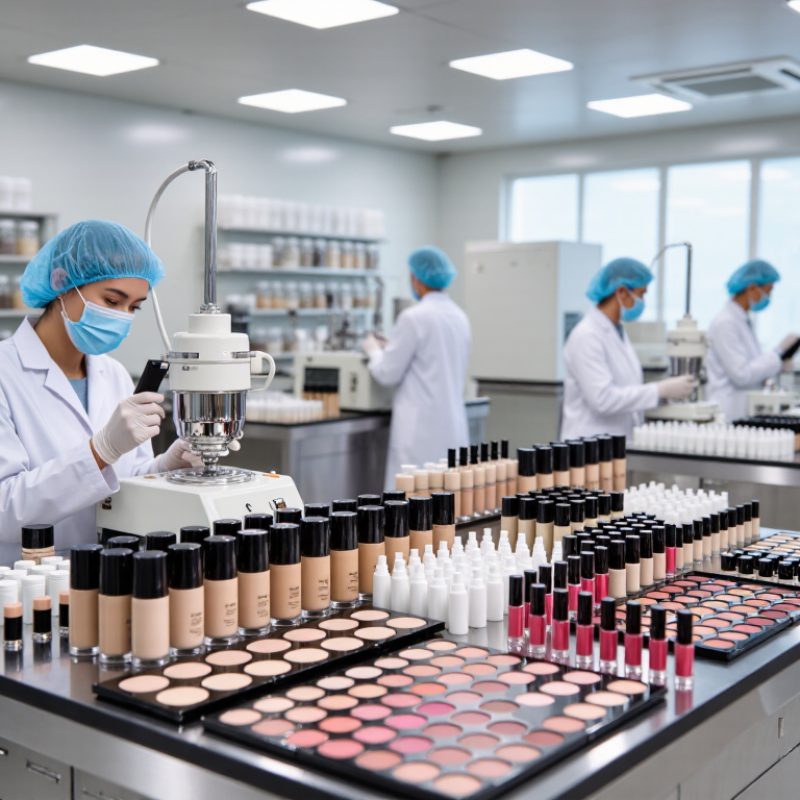
Private label makeup manufacturing means a factory makes products that are sold under a buyer’s own label. In China, the work may include formula selection, color matching, filling, packaging, and production planning. Some factories offer ready-made formulas; others can adjust texture, finish, or shade within practical limits. The buyer usually chooses the product direction and packaging, while the manufacturer manages production details. It’s a partnership, not simply a logo added to a tube.
Details matter. A lipstick sample can look smooth in a lab but feel different after filling at scale. Ask how shade consistency is checked between batches, and request samples in the final packaging. Review ingredient lists, product specifications, and relevant quality records before approving production. Packaging compatibility also deserves attention: a pump may clog, or a compact may arrive with a loose hinge. Clear communication helps, though revisions can take time. That part is easy to underestimate. A careful buyer should confirm responsibilities, testing steps, minimum order quantities, and delivery timelines in writing. No factory can remove every risk, and a rushed approval can create avoidable problems.
Choosing a private label makeup manufacturer in China takes more than comparing prices. Check whether the factory’s capabilities match your product, from powder pressing to liquid filling. Ask for current quality documents, production records, and a clear explanation of how raw materials are traced. Verify certificates with the issuing organization rather than relying on a logo in a brochure.
Request samples made with the proposed formula and packaging. Test shade consistency under daylight and indoor lighting. Check how the product applies, dries, and wears, then review stability and packaging compatibility results. Ask who handles quality checks at each production stage, and whether defects are recorded and corrected. A polished sample is useful, but it cannot prove every batch will match. No shortcut here.
Tips: Compare written quotations line by line, including sample fees, minimum order quantities, lead times, and inspection terms. Ask for a small pilot run before committing to larger volumes. Keep communication in writing, and make sure specifications are specific: shade codes, fill weight, packaging materials, and acceptable tolerances. One detail is easy to miss: confirm who owns the formula and technical files. Even careful checks leave some uncertainty, so plan for it.
Profiles of notable private label makeup manufacturers in China are best compared by specialization, not rank. One common profile is the color-cosmetics specialist, often equipped for lipsticks, foundations, and pressed powders. Ask how it controls pigment dispersion, shade matching, and batch consistency. A second profile is the integrated ODM, which may coordinate formula development, packaging selection, and production. Its broader service can save time, but buyers should check who owns each development step. A third profile is the flexible, smaller-batch supplier, useful for testing a narrow product range. Trade-offs are real. Smaller runs may mean fewer packaging choices or higher unit costs.
Market demand helps explain this variety. McKinsey’s 2023 beauty-industry report projected the global market could reach about US$580 billion by 2027, with roughly 6% annual growth. That forecast is not proof that any factory is reliable. Look for concrete evidence: dated stability-test records, packaging compatibility checks, traceable batch documents, and clear sample-revision timelines. Visit or audit where practical. A smooth sample can still conceal inconsistent production. I would treat polished presentations cautiously until the underlying process is visible.
Chinese private-label makeup manufacturers may offer color cosmetics, skincare-makeup hybrids, and packaging coordination. The range varies by factory. Some specialize in powders and pressed palettes; others handle liquid foundations, lip products, or mascara. McKinsey’s 2023 beauty market report projected global beauty sales could reach about $580 billion by 2027, with roughly 6% annual growth. That outlook supports demand, but it does not prove a supplier can meet your needs.
Production capability should be checked on-site or through a qualified audit. Ask for line capacity, minimum order quantities, equipment lists, and examples of pilot-to-production scale-up. A sample can look perfect. Scale-up is harder. For quality, request documented ingredient controls, batch traceability, stability and microbiological test records, and procedures aligned with ISO 22716 cosmetics GMP. Certificates alone are not enough; confirm their scope, validity, and issuing body. Details matter: a shade shift between batches can make a full carton inconsistent.
Tips: Send a product brief with target shades, finish, packaging, and test requirements. Review a production batch, not only a lab sample. One sourcing weakness is trusting polished presentations too quickly; factory records and repeatable test results deserve closer attention.
Product Range, Production Capabilities, and Quality Standards
How to read this chart: Bars count ISO 22716:2007 operational clause topics grouped into practical quality-system areas. This is a summary of the standard—not a manufacturer ranking, product count, or claim that any factory is certified. Check each supplier’s product range, production capabilities, and supporting quality documentation directly.
When choosing a private label makeup manufacturer in China, start with the product you plan to sell. Powder compacts, liquid foundations, and lip tints need different equipment and quality checks. Ask whether the factory regularly makes your specific product, not just whether it can make it. Request samples in your intended shades. Check color consistency, texture, scent, and wear after several hours. Small differences matter. A sample may look smooth under bright showroom lights but behave differently in everyday use.
Review quality procedures, ingredient documentation, production capacity, and communication before discussing a large order. Ask how batches are identified, how defects are recorded, and what happens when production differs from an approved sample. Confirm minimum order quantities, lead times, packaging options, and who coordinates testing and shipping. Clear written answers matter more than confident promises. If possible, arrange a factory audit or independent inspection. Check that product claims and labels are reviewed for your target markets, as requirements vary by location. A checklist helps, but it may miss problems that appear only during repeat production. I would not treat a polished catalogue as proof. The details need checking.
| Evaluation Area | What to Compare | Evidence to Request | Practical Decision Signal |
|---|---|---|---|
| Product and formulation fit | Experience with your product types, such as lipstick, foundation, eyeshadow, mascara, or face powder; available textures, shades, and finish options. | Relevant product samples, shade cards, ingredient lists, and written details of customization options. | Choose a supplier that can demonstrate the specific product performance and finish your brief requires. |
| Quality management | Documented quality procedures, batch traceability, incoming-material checks, in-process controls, and finished-product release procedures. | Current certificates where applicable, quality-system documents, sample batch records, and an explanation of corrective-action handling. | Verify certificates with the issuing body and confirm that their scope covers the relevant site and activities. |
| Cosmetics manufacturing practices | Whether the facility follows applicable cosmetic good manufacturing practices, such as ISO 22716, and how hygiene, production, storage, and documentation are controlled. | A valid certificate or audit evidence, facility details, and the procedures used for production and product handling. | Treat a certificate as one part of due diligence; check its validity, scope, and issuing organization. |
| Safety and product testing | Testing appropriate to the formula and destination market, which may include microbiological quality, stability, compatibility, and restricted-substance checks. | Test reports tied to the proposed formula, packaging, and batch; identify the laboratory and test methods. | Confirm testing requirements for the product category and market with a qualified regulatory specialist; requirements differ by jurisdiction. |
| Regulatory readiness | Ability to provide accurate ingredient, manufacturing, safety, and product documentation needed for your intended sales markets. | Full ingredient information, product specifications, safety and test documents, and clear allocation of regulatory responsibilities. | Do not assume that compliance for one market automatically satisfies another. Confirm local registration, notification, labeling, and responsible-person rules. |
| Minimum order quantity (MOQ) | MOQ by formula, shade, packaging component, and customization level; whether a trial order is possible. | A written quotation showing quantities for each SKU and any separate minimums for packaging, decoration, or custom formulas. | MOQs vary by supplier and product; compare the total launch commitment, not only the quoted unit price. |
| Sampling and product development | Sample fees, number of revision rounds, shade-matching process, approval checkpoints, and ownership of custom development work. | A documented development schedule, sample acceptance criteria, and written terms for formula or design ownership. | Approve a production-representative sample and retain a signed or otherwise traceable reference before bulk production. |
| Packaging and compatibility | Stock versus custom packaging, decoration options, component sourcing, and compatibility between the formula and its packaging. | Packaging specifications, component samples, compatibility-test results where applicable, and confirmation of who supplies each component. | Check fit, closure, dispensing, appearance, and formula condition using the final packaging configuration. |
| Production capacity and lead time | Capacity for your expected order volume, production scheduling, peak-season planning, and the stages included in quoted lead times. | A project-specific timeline covering sample approval, component sourcing, production, quality release, and dispatch. | Treat lead times as order-specific; confirm assumptions and milestone dates in writing before placing an order. |
| Pricing and commercial terms | Unit price, development charges, tooling, packaging, testing, payment terms, delivery terms, and costs for future reorders. | An itemized quotation with currency, validity period, product specifications, order quantity, and delivery basis. | Compare like-for-like specifications and total landed cost; clarify what is excluded from each quote. |
| Communication and accountability | Response clarity, named project contacts, escalation process, and willingness to document specifications and changes. | Written meeting notes, approved specifications, order terms, and a defined process for handling delays or quality issues. | Prefer precise, consistent communication over unsupported promises or unclear answers. |
| Supplier verification | Whether the contracting party is the actual manufacturer, a trading company, or a combination, and which site will make the product. | Business registration details, manufacturing-site information, a live facility review where feasible, and clear subcontracting disclosures. | Match the legal entity, production site, certificates, and contract details before making a payment. |
Note: Minimum order quantities, prices, production capacity, and lead times are supplier- and project-specific. Request current written information and verify documentation before selecting a manufacturer.