
Choosing the right Car Perfume Diffuser is more complicated than selecting a pleasant scent. Wholesale buyers must compare design, fragrance performance, safety, refill availability, and dashboard compatibility. A premium glass bottle may attract showroom customers, while a compact vent clip can suit high-volume retail channels. Each format creates a different buying experience.
Michael Edwards, a respected fragrance expert and author of Fragrances of the World, once said, “Fragrance is the invisible part of our personal style.” His observation also applies to vehicles. A car scent is not only a product feature; it shapes how drivers remember a brand, journey, or interior. For wholesalers, this makes product selection both commercial and sensory.
This guide examines ten popular types of Car Perfume Diffuser, including hanging bottles, vent-mounted units, solid fragrance cards, ceramic diffusers, and rechargeable electric models. We will consider scent diffusion, material quality, packaging, maintenance, and expected customer use. Small details matter. A loose cap can leak inside a glove compartment. An overly strong fragrance can quickly become unpleasant in a warm cabin.
No diffuser format wins every market. That is the part buyers should question. Climate, vehicle design, local preferences, and price expectations can change demand significantly. The most reliable wholesale strategy combines tested samples, clear specifications, and honest performance comparisons. Some assumptions may fail during real-world use, so practical testing should guide every final purchase decision.
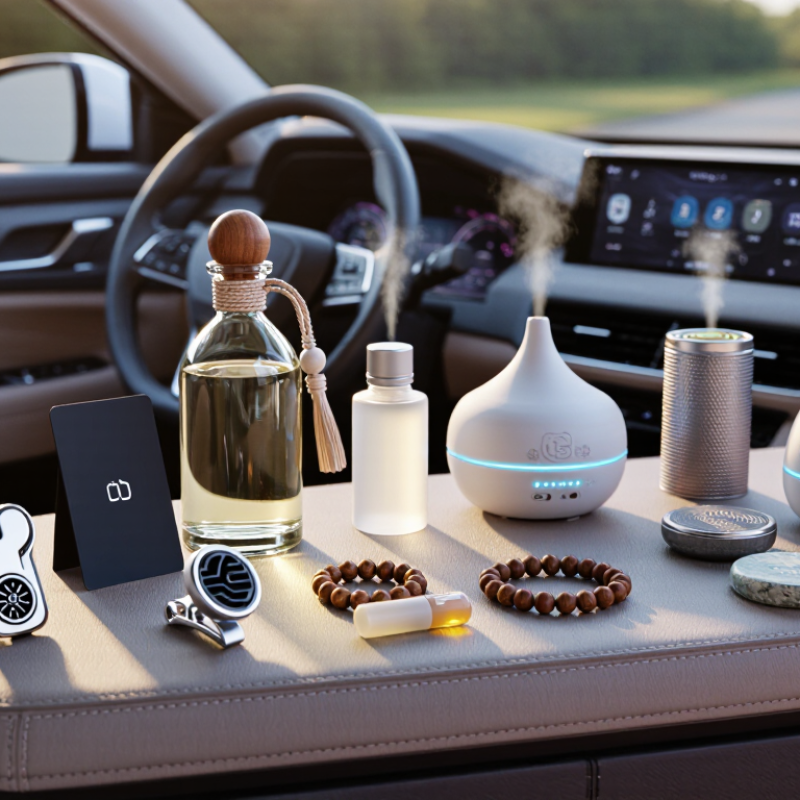
Car perfume diffusers release fragrance inside a vehicle through controlled evaporation, airflow, heat, or light mist. Their purpose is practical: reduce unwanted odors and create a more pleasant cabin atmosphere. Common wholesale types include hanging paper diffusers, vent clips, liquid bottles, solid gels, wooden caps, and electric ultrasonic units.
Hanging and wooden diffusers absorb fragrance oil, then release it slowly through exposed material. Vent clips use moving air from the dashboard vents. Liquid bottles depend on a porous stopper, while gel formats release scent as the compound gradually evaporates. Electric units may use heat or ultrasonic vibration. Each mechanism affects fragrance strength, leakage risk, refill needs, and shelf life.
Grand View Research’s air freshener market report identifies convenience and long-lasting performance as major demand factors. It also projects steady global market growth through 2030. For wholesale buyers, this supports demand for compact, low-maintenance formats. However, market data does not guarantee product success. Vehicle temperature, oil concentration, and packaging quality can change real-world performance.
Tips: Test every diffuser in hot and cold conditions. Check whether the liquid stains plastic or fabric. Review safety documentation and fragrance compliance before purchasing. Avoid promising a fixed scent duration without testing. A two-week claim may fail in direct sunlight. This is where many product descriptions become too confident. Sampling different diffuser types can reveal stronger evidence than a catalog specification.
Wholesale buyers should compare more than appearance when selecting car perfume diffusers. Common options include vent clips, hanging bottles, dashboard units, plug-in models, solid gels, wooden caps, spray bottles, ceramic pieces, bead diffusers, and refillable containers. Each format suits a different driving habit and price range.
Scent Control matters. Adjustable vents help users manage fragrance strength, while passive designs offer simpler operation. Check whether the scent remains stable in hot vehicles and during temperature changes. Leakage resistance is essential, especially for liquid-filled products. A secure cap, thick bottle wall, and tested seal reduce returns. No format is perfect.
I have inspected samples where attractive packaging hid weak clips or uneven fragrance release. That experience makes material quality worth comparing carefully. Buyers should review refill compatibility, usable capacity, packaging protection, and fragrance consistency between batches. Clear production records and safety documentation also support reliable purchasing decisions. Ask for sample testing before placing large orders. It may slow the process, but it can reveal broken hooks, faded labels, or excessive scent strength. Buyers should also compare minimum order quantities, carton dimensions, storage conditions, and customization limits. A low unit price can become expensive when damage, poor performance, or customer complaints increase.
Car perfume diffusers vary by design, scent control, and driving environment. For wholesale buyers, hanging paper diffusers remain affordable and lightweight. They suit promotional orders and short-term use. Vent clips provide stronger airflow because fragrance moves through the vehicle’s ventilation system. However, weak clips may detach on rough roads. Liquid bottle diffusers offer a premium appearance, especially with wood caps and glass containers. They need leak testing before bulk purchasing.
Gel diffusers are practical for dashboards and cup holders. Their slow evaporation can support longer use in warm climates. Electric USB diffusers provide adjustable output and a modern user experience. They suit commuters, ride-hailing vehicles, and larger interiors. Yet, buyers should check power compatibility, noise levels, and heat resistance. Small details matter.
Data from Grand View Research places the global air freshener market at about USD 12.6 billion in 2023, with steady growth forecast through 2030. The report also identifies convenience and product-format innovation as important demand factors. A 2024 IMARC Group analysis similarly highlights rising interest in vehicle fragrance products and compact dispensing formats.
These figures support multi-format sourcing, but market reports cannot replace product testing. Check scent consistency, evaporation speed, packaging damage, and performance after several hot days. Some “long-lasting” claims still disappoint in real vehicles. Wholesale selection should reflect actual use, not only attractive packaging.
Top 10 Types of Car Perfume Diffusers for Wholesale Buyers
Wholesale buyers usually compare ten formats: vent clips, hanging cards, gel cans, liquid bottles, solid blocks, spray units, plug-in diffusers, USB devices, reed-style units, and refillable pods. The format affects fragrance strength, leakage risk, and shelf life. A 2024 IMARC Group report estimated the global car air freshener market at about USD 2.1 billion in 2023. That scale rewards consistent testing, not attractive packaging alone.
Fragrance evaluation should include cold smell, first release, and performance after seven days. Strong opening notes may fade too quickly. Test woody, citrus, and clean profiles inside vehicles at different temperatures. Check whether the fragrance causes plastic, fabric, or dashboard odor changes. This assumption deserves testing. IFRA fragrance standards can support safer formulation reviews, but buyers still need supplier documents and batch records.
Material checks should cover ABS, glass, aluminum, and recyclable plastics. Examine cap fit, clip tension, surface staining, and heat resistance. Refill systems need clear volume markings and simple replacement steps. A 2023 Grand View Research analysis identified vent clips and liquid formats among important product segments, reflecting demand for convenient use. However, convenience can hide waste. Compare refill cost, packaging weight, leakage rates, and minimum order quantities. I would reject a refill design that requires tools. Small weaknesses become expensive at wholesale scale.
| No. | Diffuser Type | Typical Fragrance System | Common Materials | Typical Scent Life | Refill System | Fragrance Evaluation Points | Wholesale Advantages | Key Buying Risks | Best Fit |
|---|---|---|---|---|---|---|---|---|---|
| 1 | Hanging Bottle Diffuser | Liquid fragrance absorbed by a wooden cap or fiber wick. | Glass bottle, wood cap, cotton or fiber cord, plastic stopper. | Approximately 30–60 days, depending on heat and airflow. | Usually replaced as a complete unit; some designs support bottle-only replacement. | Check scent strength, leakage resistance, evaporation consistency, and cap absorption speed. | Low component count, strong visual appeal, and easy customization of bottle shape and label. | Potential leakage if the stopper or cap is poorly fitted; glass requires protective packaging. | Gift shops and general retail |
| 2 | Vent Clip Diffuser | Fragrance oil in a reservoir or absorbent pad distributed by vehicle airflow. | ABS or PP housing, silicone clip, felt pad, fragrance oil. | Approximately 20–45 days, influenced by fan use and temperature. | Replaceable pads, cartridges, or sealed liquid inserts. | Assess diffusion at low and high fan speeds, oil compatibility, and resistance to dashboard staining. | Compact, affordable to ship, and suitable for repeat refill sales. | Clip strength may vary between vent designs; excessive oil can damage some plastics. | High-volume automotive retail |
| 3 | Passive Ceramic Diffuser | Porous ceramic absorbs and gradually releases fragrance oil. | Porous ceramic, glazed ceramic cover, silicone base, fragrance oil. | Approximately 30–90 days, depending on surface area and oil load. | Refill drops or small refill bottles; the ceramic body can often be reused. | Test absorption uniformity, odor retention between refills, and compatibility with concentrated oils. | Premium appearance, reusable body, and a low-electronic failure rate. | Fragile in transit; porous surfaces may retain previous fragrances. | Premium gift and lifestyle stores |
| 4 | Wooden Bead Diffuser | Natural wood beads or blocks absorb essential-oil-based or perfume blends. | Untreated wood, cotton cord, elastic band, small liquid bottle. | Approximately 15–45 days per application. | Dropper refill, spray refill, or replacement scent sachet. | Evaluate wood porosity, color transfer, oil staining, and fragrance performance in warm interiors. | Lightweight, natural-looking, and economical for private-label packaging. | Uneven scent output and possible oil marks on nearby surfaces. | Eco-positioned collections |
| 5 | Felt Pad Diffuser | A porous felt pad releases fragrance after being sprayed or loaded with oil. | Wool felt or synthetic felt, plastic frame, metal or plastic clip. | Approximately 7–30 days per application. | Replaceable pads or refill spray/oil sold separately. | Check pad density, colorfastness, drying time, and fragrance consistency after repeated refills. | Very low material cost, flat packing, and many shape options. | Shorter scent life and possible pad saturation or discoloration. | Promotional programs |
| 6 | Gel Cup Diffuser | Fragrance-infused polymer gel slowly releases volatile compounds. | Polymer gel, PP or PET cup, molded lid, adhesive or holder. | Approximately 30–60 days under normal cabin conditions. | Usually a sealed replacement cup; refillable formats are less common. | Test gel stability, sweating, scent uniformity, and performance across hot and cold temperatures. | Spill-resistant design, simple merchandising, and predictable usage period. | Heat can accelerate evaporation or soften the gel; limited refill revenue. | Mass-market channels |
| 7 | Paper Card Diffuser | Fragrance absorbed into porous paperboard or cellulose fiber. | Absorbent paperboard, cellulose fiber, printed coating, elastic cord. | Approximately 1–4 weeks, depending on fragrance loading and ventilation. | Usually replaced completely; some formats allow re-spraying. | Evaluate odor strength, print ink compatibility, moisture resistance, and packaging barrier quality. | Lowest shipping volume, easy graphic customization, and suitable for large orders. | Short scent duration and possible ink or paper deformation from excess oil. | Events and fleet promotions |
| 8 | Electric Nebulizing Diffuser | A pump atomizes fragrance oil into a fine mist without adding water. | ABS or aluminum body, glass or plastic oil bottle, pump, silicone seals. | One refill commonly lasts 15–60 days, depending on settings and use time. | Replaceable oil bottles or screw-in cartridges. | Measure output consistency, noise level, oil viscosity tolerance, battery runtime, and control accuracy. | Strong scent control, premium positioning, and recurring cartridge demand. | Higher unit cost, battery or motor failures, and greater testing requirements. | Premium vehicle interiors |
| 9 | USB or Car-Powered Evaporative Diffuser | A fan or low-heat element accelerates evaporation from a pad or liquid cartridge. | ABS housing, PTC element or fan, cotton pad, USB cable, reservoir. | Approximately 20–90 days, depending on operating hours and fragrance capacity. | Replaceable pads, absorbent cores, or liquid cartridges. | Check heat management, electrical safety, airflow, noise, and scent output at different power levels. | Adjustable intensity and compatibility with common vehicle power ports. | Requires reliable electronics, may drain power, and needs careful compliance documentation. | Technology-focused retailers |
| 10 | Refillable Oil Reservoir Diffuser | A sealed reservoir feeds a wick, porous insert, or adjustable evaporation opening. | Glass or PET reservoir, PP cap, silicone seal, fiber wick, metal or plastic holder. | Approximately 30–90 days, depending on capacity and airflow control. | Replaceable fragrance oil bottles, wicks, or screw-in refill modules. | Verify seal integrity, refill compatibility, dosage control, and absence of cross-contamination. | Supports repeat purchases, reduces packaging waste, and permits multiple scent options. | Poorly designed refills may leak, fit incorrectly, or release scent too quickly. | Subscription and refill programs |
Wholesale buyers can choose from vent clips, hanging cards, bottle diffusers, gel containers, plug-ins, solid balms, sprays, USB ultrasonic units, ceramic diffusers, and refillable wood designs. Each format serves a different price point and driving habit. Grand View Research reports that the global air freshener market was valued at approximately USD 12 billion in 2023, with demand supported by vehicle ownership and personal scent preferences. However, market estimates vary by research method, so buyers should verify figures before planning large orders.
Pricing should include fragrance oil, absorbent materials, filling labor, testing, freight, and replacement parts. Low unit prices may hide weak leakage protection or unstable scent performance. Customization can cover fragrance strength, logo placement, color, shape, and refill design. Packaging needs moisture barriers, clear instructions, batch identification, and secure inner trays. Sustainable paper packaging is useful, but it still needs drop testing. I have seen attractive boxes fail during warehouse handling. That detail is easy to underestimate.
Tips: Request samples from at least three suppliers. Test scent longevity in hot and cold vehicles. Ask for material safety documents, ingredient disclosure, labeling guidance, and transport documentation. The International Fragrance Association publishes standards that help fragrance suppliers manage safe-use practices, while regional authorities may require additional labeling. IMARC’s market analysis also identifies premiumization and customization as important growth factors. Still, buyers should avoid assuming every premium design sells well. Review return rates, customer feedback, and seasonal demand before committing to a large purchase.