
China Top 10 Stainless Non Stick Cookware Manufacturers?

China’s cookware market includes factories producing stainless steel bodies, nonstick-coated interiors, and complete private-label collections. Yet “top” can mean different things: production capacity, coating consistency, export experience, customization, or support after delivery. This guide treats the list as a starting point, not a verified league table. Buyers should confirm each supplier’s current capabilities directly.

Materials scientist Mark Miodownik wrote, “Materials are the stuff of life.” His observation offers a useful lens for evaluating Stainless Non Stick Cookware: the steel grade, bonded base, coating system, and handle design all affect daily performance. A pan may look polished in a product photo. The more revealing details are its construction specifications, test records, and performance after repeated heating and cleaning.

Look closely. Ask for material declarations, coating information, sample units, and clear quality-control procedures. Check whether stated certifications can be independently verified and whether the factory can document its role in production. A trading company may suit some buyers, but it is not the same as a manufacturer. That distinction matters.

This overview will introduce ten Chinese suppliers and the questions worth asking before requesting quotations. Compare product range, minimum order quantities, customization options, lead times, and communication—not just unit price. Small details count. A loose handle, uneven coating, or vague specification can change the buying decision. Supplier claims still need checking. The right partner depends on your market, volume, quality requirements, and tolerance for risk.
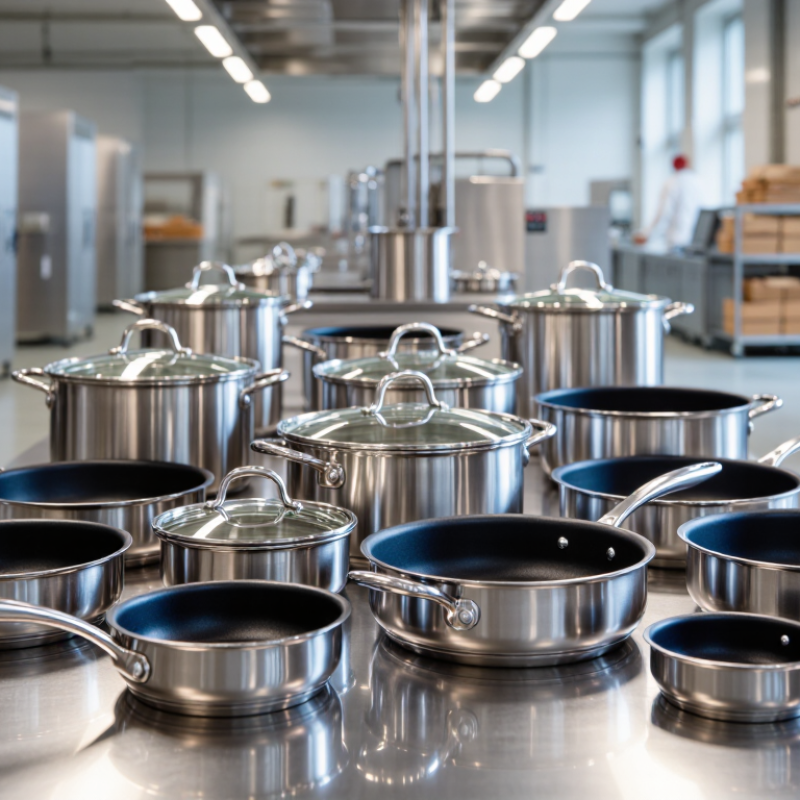
China Top 10 Stainless Non Stick Cookware Manufacturers?

Understanding Stainless Steel Non-Stick Cookware

Understanding Stainless Steel Non-Stick Cookware

Stainless steel non-stick cookware combines a durable metal body with a coated cooking surface. The steel supports the pan; the coating helps food release. These are different jobs, and construction varies. Some pans use layered metals for more even heating, while others may develop hot spots. Check the base and interior finish, not just the word “stainless.”

The broader cookware market was valued at USD 27.22 billion in 2023 and is forecast to reach USD 42.91 billion by 2032, according to Fortune Business Insights. This market includes many cookware types, not only stainless non-stick products. Still, the growth points to strong consumer interest in everyday cooking tools. It does not prove that every coating lasts equally well.

Small habits matter. Use low or medium heat, and avoid leaving an empty pan over a flame. A thin layer of oil can help with delicate foods, even on a non-stick surface. Use wooden or silicone utensils, then wash with a soft sponge. That helps. Yet coatings can wear, and care instructions differ. I would compare coating durability, pan weight, and warranty terms before choosing; appearance alone tells little. A pan that heats unevenly can still frustrate you, however polished it looks.

How Stainless Non-Stick Cookware Is Manufactured

Stainless non-stick cookware starts with stainless-steel sheet or coil. Factories cut blanks, then press or spin them into pans. The base may be bonded to a conductive metal layer for more even heating. Edges are trimmed, handles attached, and surfaces polished. Small details matter. A rough interior can weaken coating adhesion, while uneven forming may create thin spots.

Before coating, manufacturers degrease and prepare the cooking surface. They apply a primer and one or more non-stick layers, often by spraying, then cure the pan in a controlled oven. Temperature and coating thickness need close monitoring. Quality checks can include visual inspection, adhesion tests, and repeated heating cycles. Real production lines vary, and these checks do not guarantee identical performance in every kitchen.

Material supply matters too. Worldstainless reported global stainless-steel melt-shop production of 58.4 million tonnes in 2023 and 62.6 million tonnes in 2024, in its annual production figures. This signals a large, changing supply base, not cookware output specifically. That distinction is easy to miss. For buyers, useful questions include the steel grade, coating-layer consistency, and how finished pans are tested; public descriptions rarely show every factory setting.

Key Criteria for Evaluating Cookware Manufacturers

For buyers comparing stainless non-stick cookware manufacturers, evaluate evidence, not polished factory photographs. The World Stainless Association’s Stainless Steel in Figures 2024 reports 58.4 million tonnes of global stainless steel production in 2023. That scale makes material traceability essential. Ask for mill certificates identifying steel grade, thickness, and batch numbers. A sample may look convincing; production consistency is harder to judge.

Coating performance needs independent verification. Request laboratory results for adhesion, abrasion, thermal cycling, and food-contact migration. Check the test method, sample size, and report date, not just a pass stamp. ISO 2409 provides a cross-cut adhesion test, while ISO 9227 describes salt-spray testing for corrosion resistance. These tests do not prove cookware will perform well in every kitchen. Ask how results relate to repeated heating, washing, and utensil contact.

Manufacturing controls matter, too. Review incoming-material checks, coating-line records, defect handling, and final inspection criteria. Ask whether the supplier can trace a finished pan back to its production lot. Visit the factory if possible, and compare its documented process with the cookware sample you tested. Small gaps count. One awkward point: a supplier may share impressive certificates but provide little detail about routine failures. Ask for corrective-action examples, with sensitive customer information removed. That answer can reveal more than a showroom tour.

China’s Top 10 Stainless Non-Stick Cookware Manufacturers

China’s top 10 stainless non-stick cookware manufacturers are best compared by measurable production details, not polished catalog photos. A useful review checks stainless-steel grade, base construction, coating consistency, and available quality records. Details matter. Buyers should also ask whether the cookware works on induction hobs and whether handles stay secure after repeated heating.

Factory capability shows up in practical tests. A flat pan should sit steadily on a cooktop, heat without obvious hot spots, and release an egg with modest oil. Ask how coating adhesion and handle strength are inspected, and whether sample batches can be checked before larger orders. Clear answers are more useful than broad claims about durability. Ask for evidence. Also confirm packaging, lead times, and the manufacturer’s process for handling defects.

A ranking can still be imperfect because suppliers vary in specialization, order volume, and export experience. Some may excel at custom designs but offer limited testing information. Others may document production well yet have longer lead times. I would compare recent samples and written specifications before treating any “top 10” list as definitive. Even then, one overlooked detail can change the decision.

Comparing Product Ranges, Capabilities, and Certifications

Comparing China’s top stainless non-stick cookware manufacturers requires more than counting product lines. A useful shortlist should cover frying pans, saucepans, stockpots, and compatible lids. Check whether stainless steel grades, base construction, coating options, and handle designs are clearly specified. Ask for dimensions, thickness, sample photos, and product samples. Small details matter. A pan that looks sturdy online may feel unbalanced when lifted.

Manufacturing capability is equally important. Compare in-house stamping, welding, polishing, coating, inspection, and packaging processes. Request recent test reports and verify that certificates match the factory, product type, and intended sales market. Certification names alone prove little if documents are outdated or unrelated. Quality records, batch traceability, and clear defect-handling procedures offer stronger evidence. One weakness in many comparisons: quoted capacity may not reflect stable output during peak orders.

Tips: Send every supplier the same specification sheet, including pan diameter, coating expectations, packaging, and order quantity. Ask how coating adhesion and handle strength are checked, and request evidence rather than promises. Compare sample consistency across multiple pieces. It takes extra time, but that is useful. A simple scorecard for range, process control, documentation, and communication can reveal trade-offs without pretending one manufacturer suits every buyer.

Scroll to Top