China Top 10 Facial Analysis Machine Suppliers

Choosing the right Facial Analysis Machine supplier requires more than comparing product prices. It demands careful attention to clinical experience, imaging accuracy, software usability, and after-sales support. A reliable supplier should explain how its device captures skin images under controlled lighting. It should also describe the algorithms, testing methods, and maintenance process clearly.

This guide examines ten leading suppliers connected with facial analysis technology in China. The review considers manufacturing background, product design, image resolution, reporting functions, operator training, and customer service. Practical details matter. For example, a clinic may need a compact machine for a narrow consultation room. A medical spa may prefer cloud reporting, multilingual software, and fast technical support. Beauty retailers may value short scanning times and easy customer demonstrations.

Not every supplier fits every business. That matters.

Supplier information can change, and public claims may require independent verification. Therefore, this introduction does not treat market visibility as proof of superior performance. Buyers should request product samples, user manuals, warranty terms, software demonstrations, and relevant certifications before making a decision. They should also confirm how facial images are stored, transferred, and protected under applicable privacy requirements. Even well-designed equipment can produce inconsistent results when lighting, camera distance, or operator technique changes. This guide highlights promising options, but professional judgment remains essential. A thoughtful comparison can reduce purchasing risks and support more consistent skin consultations.

China Top 10 Facial Analysis Machine Suppliers

What Are Facial Analysis Machines and How Do They Work?

What Are Facial Analysis Machines and How Do They Work?

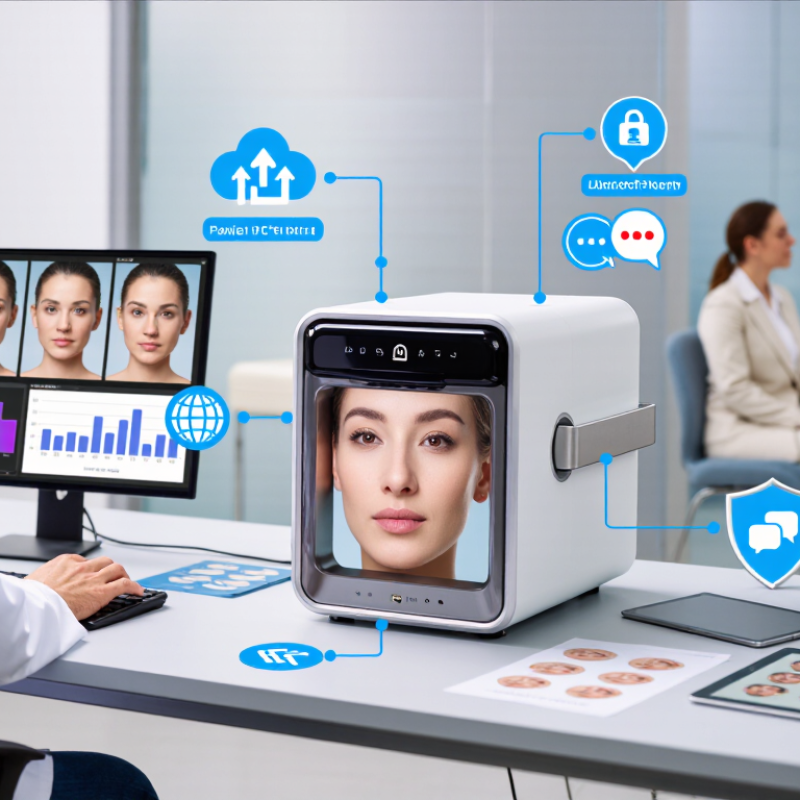
Facial analysis machines use cameras, sensors, and software to examine visible skin features. They may measure pores, wrinkles, pigmentation, oiliness, redness, and moisture. Most systems capture a face under controlled lighting. Some use polarized or multispectral imaging. The software then separates facial regions and compares visual patterns with reference data. It produces scores, images, and suggested care priorities.

The technology reflects wider computer vision growth. Grand View Research estimated the global computer vision market at USD 25.41 billion in 2023. However, market growth does not prove every skin reading is accurate. NIST testing has shown that facial algorithms can perform differently across demographic groups. Skin tone, age, lighting, and camera distance can influence results. One weak point remains.

In practical use, operators should clean the lens, control room lighting, and keep the face expressionless. They should repeat scans when results look unusual. A machine may show “high redness,” but that is not a medical diagnosis. It could reflect heat, recent exercise, or poor calibration. ISO/IEC 39794-5 also highlights the importance of consistent facial image data. I would treat the report as a screening aid, not an absolute answer. Human review still matters.

Key Criteria for Evaluating Chinese Facial Analysis Machine Suppliers

Selecting among China’s top facial analysis machine suppliers requires more than comparing resolution, screen size, or quoted prices. Grand View Research valued the global facial recognition market at USD 5.71 billion in 2022 and forecasts a 14.9% CAGR through 2030. This growth attracts capable manufacturers, but also creates noisy claims. Ask for measured accuracy, processing speed, sample conditions, and failure rates. A polished demonstration is not enough.

Independent testing matters. The NIST Face Recognition Technology Evaluation program compares algorithms across image quality, demographics, and operating conditions. Suppliers should provide comparable test results, not only internal screenshots. Check whether the machine uses visible light, near-infrared imaging, or both. Confirm its performance under glare, masks, uneven lighting, and different camera distances. Small details matter.

Security and governance deserve equal weight. Request documentation for encryption, access controls, software updates, audit logs, and data retention. Verify alignment with applicable privacy and biometric regulations in the target market. ISO/IEC 19795 offers a useful framework for biometric performance testing, while ISO/IEC 30107 supports presentation attack detection evaluation. Do not accept vague “AI-powered” language. Require a live pilot with your own workflow, operators, and lighting. The uncomfortable part is that a supplier may pass a laboratory test and still disappoint on a busy shop floor. After-sales response time, spare-part availability, SDK stability, and transparent error reporting often reveal more than a catalog. Price remains relevant, but the cheapest quote can become the most expensive decision.

China Top 10 Facial Analysis Machine Suppliers: Key Evaluation Criteria

A practical procurement-weighting model for comparing Chinese facial analysis machine suppliers without using company or brand data.

The criteria reflect common buyer priorities in professional skincare, cosmetics, dermatology, and beauty-device procurement. Product performance and measurement reliability receive the highest weighting, followed by regulatory documentation, after-sales support, customization, delivery capability, total cost, and data security. The percentages are evaluation weights rather than market-share figures.

China’s Top 10 Facial Analysis Machine Suppliers

China’s Top 10 Facial Analysis Machine Suppliers are attracting attention as salons and clinics seek measurable skin assessments. Grand View Research valued the global skincare devices market at about USD 15 billion in 2023, with strong growth expected through 2030. This demand is pushing Chinese suppliers to improve imaging accuracy, software reporting, and export support.

A reliable supplier should provide controlled lighting, calibrated RGB cameras, and repeatable measurements for pores, pigmentation, texture, and redness. Ask for test reports, sample images, software update policies, and operator training. Clear data consent procedures also matter, especially when systems store facial images. ISO 9001 supports manufacturing consistency, but it does not prove diagnostic accuracy. That distinction is often missed.

Real experience reveals practical weaknesses. A device may perform well in a showroom but struggle under bright windows or different skin tones. Request demonstrations in varied lighting conditions. TÜV Rheinland’s quality research repeatedly links customer trust with traceability and documented testing. Buyers should therefore inspect calibration records, warranty response times, and spare-part availability. Price remains important, yet the cheapest quotation can create hidden costs. Some supplier claims still need independent verification.

Product Features, Technologies, and Industry Applications

China’s top ten facial analysis machine suppliers increasingly combine RGB cameras, polarized light, and controlled illumination. These features help capture pores, pigmentation, redness, oil balance, and fine lines. Some advanced systems add multispectral imaging or 3D depth sensors. Lighting changes everything. A dark salon corner can distort skin readings.

Grand View Research valued the global facial recognition market at approximately USD 5.71 billion in 2023. Its report forecasts a 14.9% compound annual growth rate from 2024 to 2030. Facial analysis is not identical to facial recognition, but both markets benefit from better cameras, edge computing, and artificial intelligence. Reliable suppliers should disclose image resolution, calibration methods, measurement repeatability, and software update policies. A colorful dashboard alone proves little.

Industry applications include beauty consultations, dermatology support, cosmetic research, wellness centers, and retail product recommendations. Machines may compare cheek and forehead images under consistent lighting. They can also generate progress reports after several visits. However, results should support professional judgment, not replace it. Numbers need context. Skin hydration can change after washing, exercise, or weather exposure. Suppliers should provide consent controls, limited data retention, encryption, and clear error warnings. This is where many product demonstrations feel incomplete. Practical testing should include different skin tones, ages, facial conditions, and indoor environments before purchasing.

China Top 10 Facial Analysis Machine Suppliers - Product Features, Technologies, and Industry Applications
Rank Supplier Profile Typical Product Formats Imaging and Sensor Technologies Core Analysis Functions Biometric Outputs Integration and Connectivity Typical Industry Applications Common Technical Documentation
1 Profile 01
High-volume access-control supplier
Wall-mounted terminals Turnstile modules Desktop enrollment units Visible-light cameras, near-infrared illumination, wide-angle lenses, and optional depth sensing for difficult lighting conditions. Face detection, face matching, liveness detection, mask-aware recognition, and basic image-quality assessment. Face templates, verification results, confidence scores, access events, and optional attendance records. Ethernet, Wi-Fi, USB, Wiegand, RS-485, relay output, REST API, and on-premise device management. Commercial buildings, factories, campuses, residential communities, and employee attendance systems. Product datasheet, SDK/API guide, installation manual, cybersecurity statement, and test reports where applicable.
2 Profile 02
AI edge-computing supplier
Embedded AI boxes Smart cameras Industrial gateways RGB cameras, infrared cameras, GPU/NPU acceleration, and multi-camera input for edge analytics. Face detection, demographic estimation, face tracking, attribute analysis, and real-time event alerts. Face bounding boxes, tracking IDs, attribute labels, timestamps, and anonymized statistical reports. RTSP, ONVIF, Ethernet, PoE, MQTT, HTTP/HTTPS API, Docker support, and local storage. Retail analytics, transportation hubs, smart-city monitoring, building security, and industrial safety. Algorithm performance report, deployment guide, API documentation, data-processing description, and model-update policy.
3 Profile 03
Smart retail analytics supplier
Ceiling cameras Digital signage units Retail analytics terminals High-definition RGB imaging, wide dynamic range, low-light enhancement, and optional stereo or depth cameras. Visitor counting, face presence detection, dwell-time analysis, age-range estimation, and expression classification. Aggregated visitor counts, demographic categories, dwell-time metrics, heat maps, and dashboard reports. Cloud dashboard, local gateway, Ethernet, Wi-Fi, REST API, CSV export, and role-based access control. Shopping malls, department stores, advertising measurement, exhibitions, museums, and customer-flow studies. Privacy notice template, data-retention settings, dashboard manual, API reference, and calibration instructions.
4 Profile 04
Biometric enrollment supplier
Enrollment kiosks Passport-photo stations Portable capture devices High-resolution RGB imaging, controlled LED lighting, near-infrared capture, and fixed-distance capture guidance. Face image capture, pose checking, eye-state checking, blur detection, exposure checking, and presentation-attack screening. Standardized face images, image-quality scores, biometric templates, audit logs, and enrollment status. USB, Ethernet, serial ports, secure local storage, SDK integration, and encrypted data transfer. Government service centers, border-control enrollment, banking onboarding, education registration, and workforce records. Image-format specification, capture-quality guide, SDK documentation, security architecture, and maintenance manual.
5 Profile 05
Thermal and multispectral analysis supplier
Thermal screening terminals Multisensor kiosks Handheld inspection devices Long-wave infrared thermal sensors combined with RGB cameras; some systems include near-infrared imaging. Face localization, temperature-point measurement, thermal anomaly indication, identity verification, and alert generation. Thermal readings, facial images, identity-match status, alarm events, and environmental-condition records. Ethernet, Wi-Fi, HDMI, USB, relay output, local database, and optional central monitoring software. Industrial entrances, healthcare screening, laboratories, logistics facilities, and critical infrastructure. Thermal calibration data, operating-temperature range, measurement limitations, user manual, and maintenance schedule.
6 Profile 06
Banking and financial-security supplier
Branch kiosks ATM add-on modules Identity-verification terminals RGB and near-infrared cameras, controlled illumination, secure processing modules, and anti-spoofing sensors. One-to-one verification, liveness detection, document-to-face comparison, image-quality scoring, and risk-event reporting. Verification decision, similarity score, liveness result, audit trail, encrypted templates, and exception codes. Secure API, TLS encryption, HSM or secure-element integration, Ethernet, USB, and centralized monitoring. Bank branches, account opening, customer service kiosks, payment services, and regulated identity verification. Security design, encryption specification, penetration-test summary, SDK guide, audit-log format, and compliance materials.
7 Profile 07
Transportation and border-management supplier
Gate systems Self-service inspection kiosks Vehicle-entry terminals High-speed RGB imaging, infrared illumination, wide dynamic range, multi-camera synchronization, and optional depth sensing. Face capture during movement, one-to-one verification, document matching, liveness analysis, and passage-event management. Face image, biometric match result, passenger or driver event, lane status, timestamp, and exception alerts. Ethernet, industrial I/O, Wiegand, RS-232/RS-485, API integration, and redundant local storage. Airports, railway stations, ports, highway facilities, parking entrances, and controlled transport zones. Integration protocol, environmental-rating information, throughput test, lane-control manual, and maintenance documentation.
8 Profile 08
Healthcare and wellness analysis supplier
Clinic kiosks Health-assessment terminals Telehealth camera units RGB cameras, near-infrared sensors, optional thermal imaging, controlled lighting, and contactless measurement modules. Face positioning, identity confirmation, facial skin-image analysis, visible symptom indication, and measurement assistance. Patient or visitor ID, image-quality status, measurement records, appointment linkage, and operator alerts. Ethernet, Wi-Fi, USB, HL7/FHIR-ready integration where supported, local storage, and secure cloud connectivity. Hospitals, clinics, pharmacies, eldercare facilities, occupational health, and wellness centers. Operating limits, clinical-use disclaimer, calibration procedure, data-protection statement, and software user guide.
9 Profile 09
Education and workplace-management supplier
Attendance terminals Classroom devices Office access panels RGB and near-infrared cameras, compact edge processors, infrared fill light, and anti-glare display design. Face attendance, identity verification, visitor registration, mask-aware matching, and unauthorized-access alerts. Attendance logs, user IDs, access events, timestamps, exception records, and administrative reports. Ethernet, Wi-Fi, USB, relay control, cloud or local management, mobile-app interface, and web dashboard. Schools, universities, offices, factories, construction sites, and workforce time-management programs. Administrator guide, enrollment procedure, access-control wiring diagram, API guide, and data-retention settings.
10 Profile 10
OEM and project-customization supplier
Embedded modules Custom kiosks Private-label system platforms Configurable RGB, near-infrared, depth, and thermal sensor combinations selected according to project requirements. Face detection, recognition, liveness detection, attribute analysis, image-quality assessment, and customized workflows. Configurable biometric templates, verification results, event logs, analytics outputs, and customer-defined data fields. Custom SDK, REST API, MQTT, Ethernet, Wi-Fi, USB, serial communication, edge deployment, and private cloud options. Security projects, smart buildings, retail, manufacturing, public services, transportation, and specialized OEM equipment. Customization specification, interface-control document, source-code escrow terms where agreed, test plan, and acceptance criteria.
Technical specifications vary by configuration and project requirements. Face-analysis systems should be evaluated for image quality, presentation-attack detection, interoperability, cybersecurity, privacy protection, environmental performance, and compliance with applicable laws before procurement.

How to Select the Right Chinese Supplier for Your Business

China Top 10 Facial Analysis Machine Suppliers

How to Select the Right Chinese Supplier for Your Business

China offers many facial analysis machines, but a low quotation should not decide your purchase. The adjacent facial recognition market may reach USD 8.5 billion by 2027, according to MarketsandMarkets. This growth increases supplier variety and marketing noise. Ask for a live demonstration using different skin tones, lighting conditions, and camera distances. A polished showroom test is not enough.

A polished showroom test is not enough.

Check the machine’s sensors, calibration process, software update policy, and report format. Request sample reports with measurable indicators, not vague “skin age” claims. NIST’s Face Recognition Vendor Test reports show that demographic performance can vary across systems. Facial analysis suppliers should therefore explain their validation methods clearly. Look for repeatability data, error ranges, and testing conditions.

Numbers matter.

Experience also matters. Ask whether the supplier can provide installation training, spare parts, remote support, and English technical documents. Confirm production lead time and inspection procedures before payment. A reliable supplier should explain data storage, user consent controls, and access permissions. These details affect daily operations and customer trust.

I would not accept a supplier that hides limitations.

Some reports may appear scientific but remain difficult to reproduce. Test at least two units from the same production batch, then compare results over several days.

Scroll to Top